The Corkboard Conundrum: How Langton Decides What the Village Gets to See
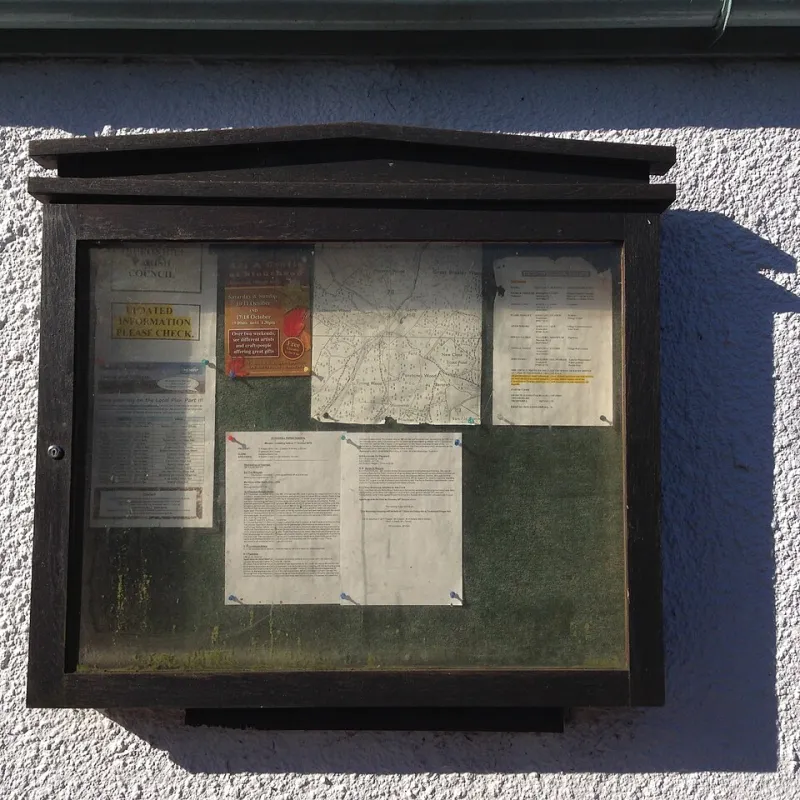
Photo: James Harrison , CC BY-SA 2.0, via Wikimedia Commons
On a damp November morning in Langton, the village noticeboard can tell you more about who is speaking to whom than any social media feed. A charity coffee morning, a council meeting notice, a lost cat, a planning application, a vaccination clinic and, sometimes, a political leaflet all compete for the same few square feet of cork. The board is easy to overlook. It is also one of the few remaining public spaces where information is displayed without an algorithm deciding who sees it first.
That apparent openness is now under scrutiny. In 2026, removals from noticeboards in and around the village have prompted questions about who gets to pin up a poster, who decides what stays and on what authority. The answers are less straightforward than residents might assume. Langton has no single noticeboard empire. Boards are owned by different bodies: the parish council, the village hall, the church, shops and community groups. Each has its own habits, and only some have written rules.
A Small Space With a Long Reach
The parish council's boards are the most visible. They carry statutory notices, meeting agendas, planning lists and public service messages. Because they sit on public property and are maintained at ratepayers' expense, they carry an expectation of neutrality. A resident who sees a poster on a council board may reasonably assume that the council has approved it, or at least that it has not objected. That assumption is not always safe. A board can be a council asset without every pin being a council endorsement.
Ownership matters. A board attached to the village hall may be governed by the hall committee. A board outside a shop is private property. A church board serves a different purpose. The parish council can set rules only for boards it controls. It cannot dictate what appears on a landlord's wall or a charity's noticeboard. This patchwork is normal in village life, but it makes the question of control harder to answer than a single policy might suggest.
The Written Rules, and the Gaps Between Them
Where written rules exist, they tend to cover the basics. Requests are made to a clerk or caretaker. Posters must be dated, of a reasonable size and connected to the village or its surrounding communities. Commercial advertising is usually restricted. Out-of-date notices are removed. Party-political material may be treated differently from a church fete or a road closure. The details vary from board to board, and that variation is where disputes begin.
The gaps are not necessarily evidence of bad faith. Volunteers and clerks manage boards alongside many other duties. A poster that is slightly too large, or pinned over a council notice, may be moved without a formal record. A community group may leave an event notice up for weeks after the event because no one has the key to the case. A political leaflet may be removed because it appears partisan, or because it is taking up space that a statutory notice needs. In each case, the intention may be administrative rather than political. The effect, however, can look like censorship to the person whose poster has disappeared.
When a Poster Comes Down
Removal is the point at which noticeboard policy becomes visible. In 2026, Langton has seen the familiar pattern: a poster is taken down, the group that placed it asks why, and the answer depends on who is asked. Sometimes the reason is straightforward — the event has passed, the board is full, the poster was never approved. Sometimes it is less clear. Was the removal recorded? Was the group told? Was there a right to appeal? If the answer to those questions is no, a small administrative act can become a grievance.
A transparent process would not need to be elaborate. A dated log of removals, a named contact and a short written reason would resolve most confusion. So would a clear statement of priorities: statutory notices first, then council information, then community notices, with political material subject to a published neutrality rule. Such a framework would not eliminate judgment calls, but it would make them easier to explain.
The Political Test
Political material is the hardest case. A parish council must not use its resources to promote a candidate or a party. It must also respect lawful freedom of expression. The line between a community campaign and a partisan leaflet can be blurred. A poster opposing a housing development, supporting a bus service or criticising a council decision may be political in content without being party-political. A notice from a residents' group may be both civic and contested. A blanket ban is simple, but it may exclude legitimate debate. A permissive approach is open, but it can turn a public board into a campaign surface.
The safest route is a written distinction. Party-political material can be excluded from council boards, while non-partisan community notices are admitted under clear criteria. That distinction should be published, applied consistently and reviewed. It should also be explained to residents, because a rule that exists only in a clerk's file is not really a public rule.
An Information Network Hiding in Plain Sight
Noticeboards matter most to people who are not online. They serve residents who do not use social media, visitors who pass through the village and anyone who wants to see a council notice without hunting through a website. Their physical condition therefore has a public value. A board without lighting, a case that leaks or a location away from the main footfall is not neutral infrastructure. It shapes who receives information and who does not.
For Langton, the practical questions are modest but important. Which boards does the parish council actually own? What policy applies to each? Who removes posters, and how is that recorded? Are political and community notices treated under the same written rules? Could a simple map of boards, published online and in the village, help residents know where to look?
The corkboard is a small stage, but it is still a public one. The decisions made about it — who may pin, who may remove and who must explain — are council decisions about access. They deserve the same scrutiny as any other.