The Safety Ledger: How Langton’s Playground Equipment Is Checked, Recorded and Repaired
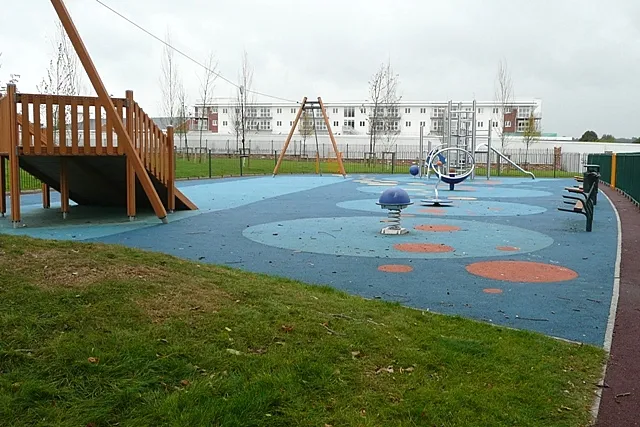
Photo: Graham Horn, CC BY-SA 2.0, via Wikimedia Commons
On a damp November morning in Langton, the most consequential document in a children’s play area is rarely the one in plain sight. It is not the warning sign, nor the sticker on the swing frame. It is the inspection log held by the council’s grounds team: a running record of dates, initials, defects, risk ratings and repairs. The sticker tells you that someone has looked. The file tells you what they found, what was done, and what was left for another week.
That distinction matters as parents, carers and residents weigh how safe the village’s public play equipment really is. Langton’s playgrounds are not inspected by accident or goodwill alone. They sit within a formal regime shaped by British standards, insurance requirements and the council’s own maintenance contract. But a regime is only as good as its records — and records are only useful if residents know what they can ask for.
The inspection timetable: who looks, and how often
Langton’s play equipment is subject to a layered system. Routine visual checks are the most frequent. These are typically carried out by the grounds maintenance team or its contractor on a weekly or fortnightly cycle, looking for obvious hazards: broken swings, exposed bolts, damaged surfacing, litter or vandalism. A more detailed operational inspection follows at longer intervals — usually monthly or quarterly — and examines wear, stability and moving parts more closely.
The third layer is the annual independent inspection, often carried out by a specialist play safety organisation such as RoSPA. That assessment considers the equipment against the relevant British and European standards, including BS EN 1176 for play equipment and BS EN 1177 for impact-absorbing surfacing. The council’s insurer is likely to expect evidence of this schedule, not because insurance replaces safety, but because documented inspection demonstrates reasonable care.
The logs themselves are usually unglamorous. A page may record that a swing seat was worn, that a roundabout bearing was stiff, or that a section of wet-pour surfacing had lifted at an edge. Each entry should carry a date, an inspector’s initials, a description of the defect, a risk rating and an action: repaired, monitored, or taken out of service. When equipment is cordoned off, the log should explain why and when it is expected back.
What the log records — and what it leaves out
The strength of the inspection file is that it creates a chronology. If a defect was reported on a Monday and fixed on a Thursday, the paper trail shows it. If a piece of equipment was tagged out of use for three weeks, the file should show the reason: a part on order, a contractor unavailable, or a decision that the repair was not cost-effective.
The weakness is that logs often record the what and the when, but not always the why. A resident may see a missing swing seat and assume neglect. The file may show a specialist part was ordered, or that the council was weighing repair against replacement. Those are different stories, and the difference matters. Residents can reasonably ask for the inspection record for a named play area, the latest annual assessment, and the council’s repair timescales. They can also ask which officer or contractor is responsible for acting on defects and how delays are escalated.
Accountability in Langton sits in several places. The grounds maintenance contract sets out inspection frequencies and response times. The council’s responsible officer oversees the contract. The relevant committee or portfolio holder holds the budget and the public answer. And the insurer holds the council to the standard of reasonable care. None of these is a guarantee that every repair will be immediate, but together they form the chain that residents can question.
Repairs, budgets and the priority problem
Play equipment maintenance is rarely a single budget line. Routine repairs usually come from revenue budgets, while replacement of major items may require capital funding and committee approval. That split can create friction. A worn swing seat is a quick revenue fix. A failing climbing frame is a capital decision. When money is tight, the temptation is to keep equipment in service for longer, monitoring defects rather than replacing them.
The inspection logs are where that tension becomes visible. A risk rating may say a defect is low or moderate, allowing continued use under observation. But risk ratings are judgements, not certainties. Residents should be able to see whether a defect has been re-logged repeatedly without repair, and whether the council has set a date for action. The most useful question is not simply “is it safe?” but “what does the file say, and who has signed off the decision to leave it?”
Insurance, liability and the limits of a sticker
Public liability insurance is a backstop, not a substitute for maintenance. Insurers typically require documented inspection regimes, defect reporting and reasonable response times. A well-kept log is evidence that the council has taken its duties seriously. It does not make an accident impossible, and it does not automatically settle questions of liability. What it does is show whether the council knew about a problem and what it did next.
For parents and carers, the practical point is that a sticker or an inspection tag is a prompt, not a conclusion. If a piece of equipment looks damaged, reporting it to the council creates a record. If the same defect persists, asking for the log entry creates accountability. The system works best when residents use the paper trail as well as the playground.
What residents can reasonably ask
Langton residents can raise play equipment at a public council meeting, in writing to the grounds service, or through a Freedom of Information request where the information is not already published. Reasonable requests include: the inspection schedule for each play area; the most recent annual independent report; the defect log for a named site; the council’s repair timescales; the maintenance budget for play equipment; and the contractor’s performance against response targets. Residents can also ask which equipment is currently out of service and what decision has been taken about its future.
The answers may not always be quick, and they may not always be satisfying. But the safety file is not a bureaucratic relic. It is the mechanism by which a promise on a playground post becomes a decision with a date, an owner and a cost. In Langton, as elsewhere, the question is not whether the swings are inspected. It is whether the ledger behind them is complete — and whether anyone is reading it.