Beyond the Last Drop-Off: Langton’s Mobile Library Route and the Readers at Its Edge
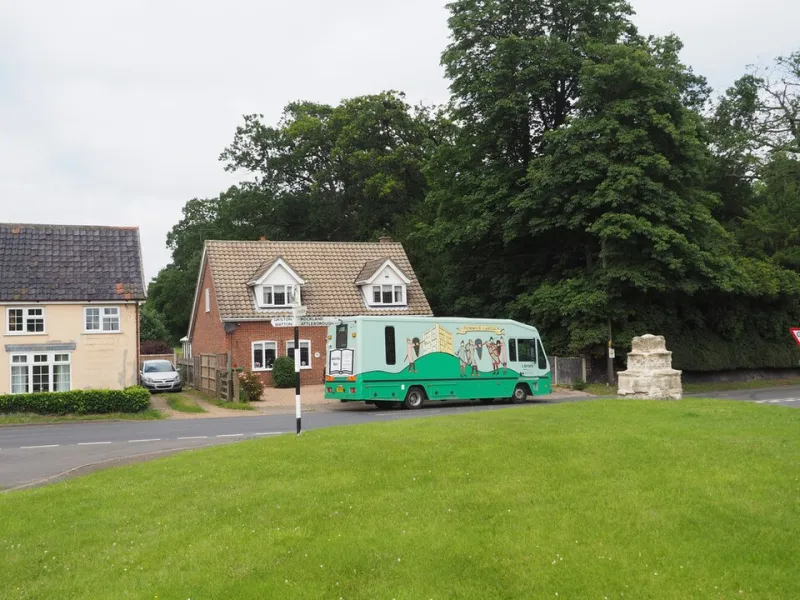
Photo: David Pashley , CC BY-SA 2.0, via Wikimedia Commons
The mobile library van still pulls into Langton’s market square on a Tuesday, but the timetable pinned inside its door tells a story of quiet subtraction. The published autumn 2026 schedule lists eleven stops across the route, down from fourteen in 2023. Three hamlets that once received a fortnightly visit now see the van every four weeks. None of the changes was announced as a closure. Each was recorded, instead, as a timetable adjustment.
That distinction matters in a parish where the nearest static library is a bus ride and a walk away for many residents. The mobile service is not simply a delivery mechanism for books. It is a recurring appointment, a check-in and, for some households, the most reliable weekly conversation with someone outside the family. The question now facing Langton Council and the county library authority is whether a timetable adjustment is a neutral act of scheduling or a decision about rural access by another name.
A Timetable as a Budget Document
The route’s funding is split. The county council’s library budget covers the vehicle, staff and stock, while Langton Parish Council contributes a small sum through its public services precept. That contribution is reviewed annually, and this year it was held flat. The county authority, meanwhile, has been reorganising its library estate since 2024, consolidating back-office functions and reviewing what it calls ‘mobile and outreach provision’.
In practice, the review has produced a route that is shorter in distance and longer in interval. Council papers from the library authority’s September 2026 meeting describe the changes as ‘efficiency measures designed to protect the overall mobile offer’. They do not use the word ‘cut’. But the schedule itself is a budget document in miniature: fewer stops mean fewer hours on the road, and longer gaps mean the same staff can cover more ground elsewhere.
The Arithmetic of a Stop
Usage figures released to the Langton Times under a freedom of information request show 1,842 visits across the route in 2024–25, compared with 2,410 in 2022–23. The decline is not uniform. Stops in the larger villages have held up reasonably well; the sharpest falls are at the hamlets now served every four weeks. That pattern is familiar to anyone who has watched rural services contract: frequency falls, usage falls, and the reduced usage is then cited as evidence that the service was underused.
The council’s own performance measure complicates the picture. A ‘visit’ is counted when a resident boards the van, not when a household uses the service through a friend, a neighbour or a pre-ordered bag. In small communities, the person who collects books for an housebound neighbour is not recorded as a user. The figures are not wrong, but they are thin. They measure footfall, not reach.
Who Is Counted, and Who Is Not
At Beckford End, the van now arrives on the first Thursday of the month. Margaret Ellison, 78, has used the service for eleven years. ‘It is not only the books,’ she said. ‘It is knowing that someone will be there, and that they will ask how you are. When it was fortnightly, you could plan around it. Now you have to remember which Thursday it is.’
A parent in Ashby Parva described a different problem: the four-week gap falls awkwardly against school holidays and work patterns. ‘We used to treat it as a Saturday routine,’ she said. ‘Now it lands on a weekday morning and I cannot always get there.’ Neither resident asked for the service to be immune from review. Both asked for the timetable to be explained in terms they could use.
The Rural Access Promise
The county’s 2026–30 library strategy states that it will ‘maintain a mobile offer that reaches communities more than three miles from a static library’. By that measure, the current route still complies. All eleven stops sit beyond the three-mile threshold. But the promise is about reaching communities, not about how often. A monthly visit is a form of reach. So is a quarterly one. The strategy does not say which.
That ambiguity is where local scrutiny becomes useful. Langton Parish Council’s public services committee has asked the library authority for a breakdown of cost per stop and cost per visit. The request is scheduled for the committee’s January meeting. Councillors have also asked whether the three hamlets can be restored to a fortnightly schedule on a trial basis, with usage monitored over six months.
Questions for the January Meeting
The answers will depend on how the authority defines its obligations. Residents who want to press the point can ask four questions. First, what is the cost per visit at each stop, not simply the average across the route? Second, how does the authority count households that use the service indirectly? Third, what notice does it give before a stop is moved or reduced? Fourth, is there a formal process for a parish council to request a trial restoration?
None of these questions is hostile. They are the ordinary questions of a public service that has changed its pattern without changing its promise. The van still comes. The readers at the end of the route are still there. What has changed is the rhythm of the thing, and the ease with which a monthly visit can become a memory of a fortnightly one.
The mobile library will next call at Langton market square on Tuesday 17 November 2026. The timetable is available from the parish office and on the library authority’s website. Residents who wish to comment on the route can do so at the public services committee meeting in January, where the authority’s written response is expected to be tabled.