The Flood Duty Map: What Langton Residents Can Ask, and of Whom
Flooding in Langton is rarely the work of a single agency. A blocked gully, a swollen brook, a saturated field and a new hardstanding can combine to send water across a lane long before any official warning is issued. When residents reach for the phone, the first question is often the most awkward: who is actually responsible? The answer, in 2026, is a chain of bodies rather than a single command. Understanding that chain is not bureaucratic pedantry. It determines how quickly a report reaches the right desk, whether sandbags appear and how far an objection to a flood-risk development can travel.
A chain, not a command
Langton Parish Council is closest to the ground. It can maintain a community flood plan, coordinate volunteers and pass on warnings from the Environment Agency. It does not, however, own the public drainage network or the highways. The district council handles planning, land drainage in some circumstances and emergency planning as a category one responder. The county council, as highways authority and lead local flood authority, has a central role in road gullies, ordinary watercourses and surface water. The Environment Agency is the body for main rivers and tidal flood warnings. Water companies deal with public sewers. Each has a different trigger, a different out-of-hours number and a different record.
That division is sensible on paper. It becomes less clear when a caller cannot tell whether the water on the road came from a highway gully, a private pipe, an ordinary watercourse or a sewer. The temptation is to ring the parish council first because it is local. That may be good for local intelligence, but it does not always start the statutory clock.
Gullies: the first call is usually the county
For standing water on a public road, the county highways team is normally the right starting point. Its gully clearance programme is risk-based rather than reactive, so a report is not a work order. Residents can help by giving an exact location, a photograph and a note of whether the water is rising or stable. It also helps to say whether the gully is visibly blocked by leaves, silt or debris, and whether nearby drains are backing up.
A parish councillor can escalate a persistent problem, but the parish does not hold the highways maintenance budget. The distinction matters because a report that is logged in the wrong place can look like action without producing any. For ordinary watercourses, the county as lead local flood authority has a role in consenting and enforcement, while the district may own or manage land drainage in particular cases. For public sewers, the water company is the first port of call. Where a private landowner is responsible, the council can advise but cannot always compel immediate work.
Sandbags: local arrangements, not a universal right
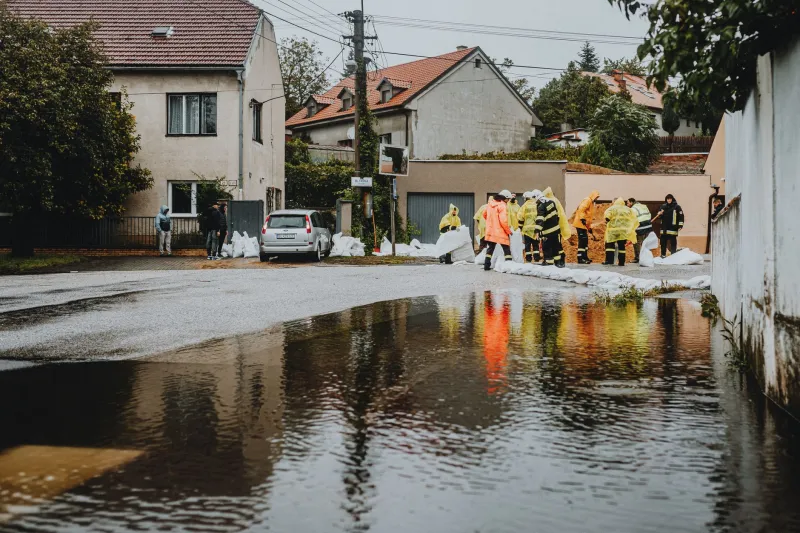
There is no general statutory duty for councils to supply sandbags to every household. In practice, local arrangements vary. Langton's community flood plan sets out what volunteers can do and where residents should turn, but it is not a substitute for the emergency services. If there is a risk to life, the advice is to call 999. For property flooding, residents should contact the district council's emergency planning team and the Environment Agency Floodline, as well as their water company if sewage is involved.
That patchwork can feel unsatisfactory at the moment it matters most. A householder may find that the parish has a small stock for community use, the district has a different policy and the county is concerned only with the highway. The result is not necessarily a failure, but it is a gap in expectation. The useful question is not simply whether sandbags exist, but who decides when they are deployed, how vulnerable residents are identified and what happens outside office hours.
Development: consultee by consultee
When a planning application is submitted in a flood-risk area, the district council is the decision-maker. The Environment Agency is a statutory consultee for certain major or high-risk proposals and advises on main rivers and flood risk. The county, as lead local flood authority, advises on surface water drainage and sustainable drainage systems. The parish council is a consultee and can reflect local knowledge, but it does not determine the outcome.
Residents who wish to challenge a proposal can comment on the application, pointing to the drainage strategy, the sequential approach to site selection and any evidence that the scheme would increase flood risk elsewhere. Conditions can require drainage details before work begins, but conditions are only as good as their enforcement. A useful scrutiny question is whether the council has the staff to check that what was approved is what gets built.
The gaps that show at high water
The weak points tend to appear at the joins. A gully that discharges into an ordinary watercourse may be the county's concern until it reaches the district's. A private culvert may be the landowner's responsibility until it blocks and floods the road. A parish warning may reach some residents quickly and others not at all. Records are held by different bodies, in different formats, and are not always joined up when an emergency response is being coordinated.
None of this means that no one is in charge. It means that responsibility is distributed, and distributed responsibility depends on clear handoffs. The test is not whether each organisation can point to its own remit. It is whether a resident reporting water at the door can be routed to the right place without being sent around the houses.
Questions worth asking before the next warning
Ratepayers can reasonably ask the parish, district and county to publish a single flood contact map for Langton. They can ask which gullies are on the routine schedule and which are known problem sites. They can ask how sandbag decisions are made and how vulnerable households are contacted. They can ask how drainage conditions on new developments are checked after permission is granted. And they can ask whether the community flood plan is exercised, not merely written.
High water exposes more than blocked drains. It exposes the seams between authorities. Langton's flood response will be judged less by the number of bodies with a role than by whether residents can find the right one before the water reaches the door.