The Four-Minute Question: Langton's Defibrillator Map and the Hamlets Beyond It
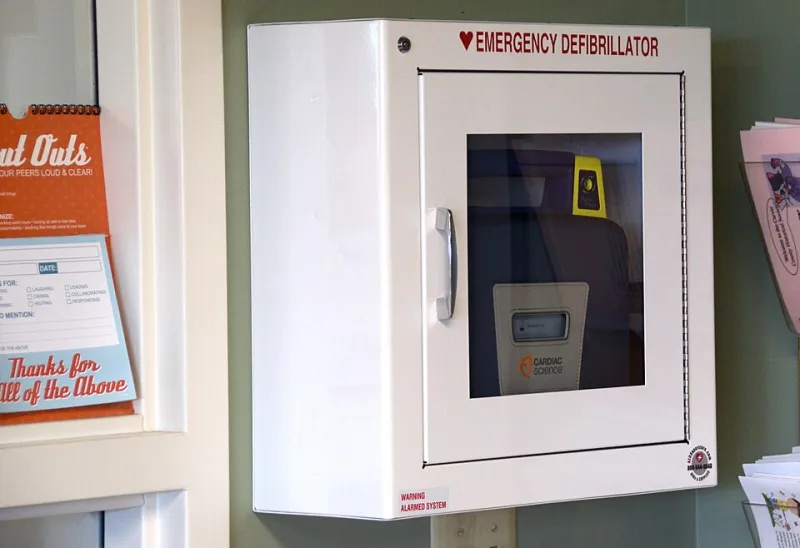
Photo: Myotus, CC BY-SA 4.0, via Wikimedia Commons
On a damp November morning, the cabinet on the wall of Langton Village Hall is easy to miss. It is grey, waist-high and marked with the familiar green sign. Inside is a defibrillator that could, in the right circumstances, restart a heart before an ambulance arrives. As of 12 November 2026, Langton Times has counted eight public-access defibrillators in the parish and its immediate surrounds. The picture is not one of neglect. It is one of unevenness: a well-equipped village core, a handful of devices whose registration is uncertain, and outlying hamlets where the nearest cabinet is a drive, not a walk, away.
The inventory: eight cabinets, three questions
Our audit draws on site visits, information supplied by keepers and records available to the parish council. For each device, three questions matter most: who owns it, whether it is registered with the ambulance service through The Circuit, and who will pay when the pads and battery expire.
| Location | Keeper | Access | Registered with The Circuit | Consumables due |
|---|---|---|---|---|
| Langton Village Hall | Village hall committee | 24-hour external cabinet | Yes | Pads February 2027; battery 2028 |
| Langton Co-op | Retailer | Store opening hours | Yes | Pads September 2027 |
| The Royal Oak | Pub landlord | Porch cabinet during opening hours | Not confirmed | Pads January 2028 |
| Langton Medical Centre | GP practice | Surgery hours | Yes | Pads November 2027 |
| Langton Sports Pavilion | Sports club | External cabinet, code from club | Yes | Pads March 2027 |
| St Mary's Church | Parochial church council | Church opening hours | No | Pads 2027 |
| Marsh End phone box | Parish council | 24-hour external cabinet | Yes | Pads December 2026 |
| Foxley Farm Shop | Business | Shop opening hours | No | Pads 2027 |
Two hamlets, Upper Langton and Broomfield, have no public-access device within their boundaries. The nearest cabinet to Upper Langton is at the village hall, roughly 2.6 miles by road. For Broomfield, the nearest is the Marsh End phone box, about 1.9 miles away.
Registration is not a technicality
A defibrillator that is not on The Circuit, the national database run by the British Heart Foundation and shared with ambulance services, may still be found by someone who knows it is there. But a 999 call handler may not be able to direct a caller to it. In a cardiac arrest, that difference matters. The Circuit allows ambulance control rooms to point bystanders to the nearest registered device and to give access details where a cabinet is locked.
Registration is only half the task. Details must be kept up to date. A device registered three years ago may since have moved, changed access arrangements or been removed during building work. Keepers should check their entry at least annually, and again whenever a cabinet is relocated or a premises changes hands. Residents can ask whether the devices they can see are registered, and whether the access information held by the ambulance service is current.
Who pays when the pads expire
Defibrillators are durable, but their consumables are not. Pads have a shelf life, typically between two and five years, and batteries must be replaced. Costs vary, but a set of pads and a battery can run to tens of pounds per device, and more for some models. Across eight devices, that is not a trivial sum, particularly when several fall due in the same year.
There is no general legal duty on a parish council to provide defibrillators. Councils may fund them, and many do, but the money has to come from somewhere: the precept, a grant, fundraising or a local business. The risk is not usually the initial purchase. It is the quiet year, several years later, when the pads expire and no one has budgeted for replacements. Residents should ask who holds that responsibility, where the record is kept and what happens if a device is found to be out of date.
The gaps beyond the village core
Langton's village centre is not badly served. The village hall, the Co-op, the medical centre and the sports pavilion give several options within a short distance. The question is whether the same can be said for the hamlets. Distance by road, the time taken to find a cabinet and whether it is accessible out of hours all affect the practical value of a device.
Marsh End has a cabinet, but its pads are due to expire in December 2026. That is not a reason for alarm; it is a reason for a check. Upper Langton has no cabinet at all. Broomfield relies on a device in another hamlet. These are the places where a coverage assessment, rather than a simple count of devices, would be useful. A map that shows only where defibrillators are, without showing where people live and how long it takes to reach a cabinet, tells only half the story.
Questions to put to the parish council
Residents can reasonably ask the parish council to publish an asset register of every defibrillator on its land or maintained with public money. They can ask which officer or volunteer checks each device, how often, and where the record is kept. They can ask what sum has been set aside in the 2027–28 budget for pads and batteries, and what happens when a grant or sponsorship ends.
Further questions follow. Will the council assess coverage in Upper Langton, Foxley and Broomfield against road distance and likely ambulance response? Are access codes shared with the ambulance service and updated when locks change? Is there a plan for unheated cabinets in winter, when batteries can suffer? And will the council publish a simple map, online and on noticeboards, showing each public-access device and its hours?
Questions for businesses and other keepers
Businesses and voluntary groups that keep a defibrillator can also be asked a short set of questions. Is the device on The Circuit? When was it last checked? Are the pads in date, and who pays for replacements? Is it available when the premises are closed? If not, is that made clear? Could the keeper host an external cabinet, or share access arrangements with the ambulance service?
What residents can do
The most useful step is often the simplest: ask. A request to the parish council for a defibrillator register, or to a shop for confirmation that its device is registered, creates a record and prompts a check. Residents can also learn where their nearest cabinet is before an emergency, and encourage keepers to review expiry dates. None of this replaces calling 999 or starting CPR. It supplements them.
Langton is not starting from zero. It has devices, keepers and a village core that is, on the whole, covered. But a map is only useful if it is accurate, and an accurate map depends on registration, maintenance and money. As several pads approach expiry, the question is not whether Langton has defibrillators. It is whether the right devices are in the right places, known to the ambulance service and paid for when the time comes. That is a council decision, a business decision and, ultimately, a community one.