A Place to Sit and a Place in the Queue: How Langton Allocates Its Memorial Benches
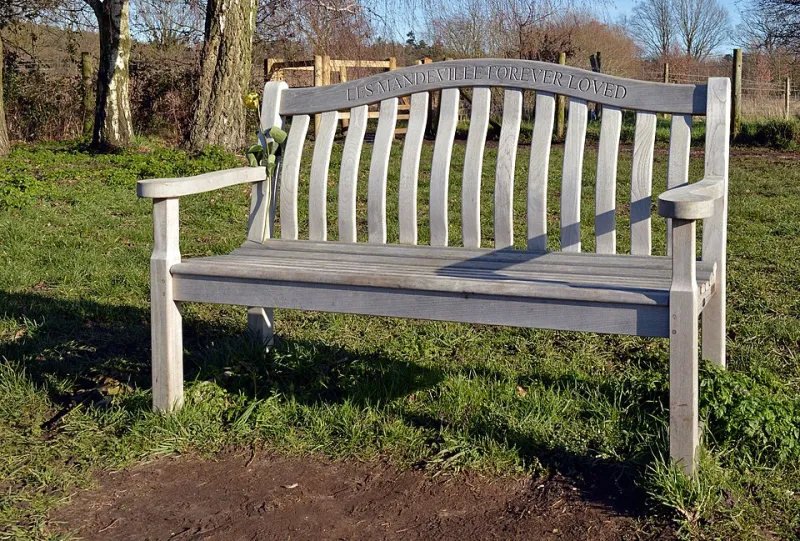
Photo: Lewis Hulbert, CC BY 3.0, via Wikimedia Commons
There are perhaps forty benches within the parish boundary, and almost every one of them carries a small plate of engraved brass or steel. Some commemorate a parent, some a walker, some a dog. To the passer-by they are simply places to sit. Behind each is a request, an approval, a payment and — more often than the council would like to admit — a wait.
What the policy permits
Langton's memorial bench arrangements rest on a distinction that matters a great deal and is easily missed. A family may donate a bench, which the council then adopts and maintains, or the council may permit a bench on its land that remains the family's property. The first route carries an expectation of enduring care; the second places the burden of upkeep on the donor, and the council's consent can be withdrawn if a bench becomes unsafe.
Engraving is a separate matter again. Plates must meet specified dimensions, wording is subject to approval, and the council reserves the right to decline inscriptions it considers unsuitable. In practice, refusals are rare and usually concern length rather than sentiment.
The plaque and the price
The published scale of charges covers the bench itself, the plate and an endowment sum intended to fund inspection and repair over the life of the item. It is the endowment that families most often query, and it is also the part of the arrangement that protects them: a bench without a maintenance provision becomes, within a decade, a splintered liability that the council will eventually remove.
Costs vary with the type of seat. A standard timber bench with a modest plate sits at the lower end; a heavier recycled-material seat with a longer inscription sits higher. Families are free to source their own bench, but the saving is frequently eroded by the cost of making it compliant with the council's specification.
Why some families wait longer than others
Here the queue begins. The council does not maintain an open list in the sense of a housing register; instead, requests are considered against available locations. Certain positions — along the main recreation ground path, facing the water, near the churchyard gate — are effectively full, and have been for some years. A request for one of those places is not refused so much as deferred indefinitely.
Other sites are constrained by practicalities that are rarely visible to the applicant. A bench requires a level base, clearance from a footway of adequate width for a pushchair or a wheelchair, and a position the grounds team can reach with a mower without repeatedly dismantling the seat. Ground that floods in winter is unsuitable regardless of how fine the view.
There is also a sequencing point that causes understandable frustration. Where two requests arrive for the same desirable spot, the council has generally proceeded on the order in which complete applications — bench specification, inscription wording, fee and consent — were received. A family that enquires early but returns its paperwork late will find itself behind one that enquired a fortnight later and completed everything at once.
Maintenance, removal and the awkward cases
Benches are inspected as part of the council's wider grounds regime, and a seat found to be structurally unsound is taken out of use, sometimes permanently. When that happens with an adopted bench, the council's obligation is to repair or replace within the terms of the original agreement. With a privately owned bench, notice is given to the family and the outcome depends on their response.
The most difficult cases involve benches placed without consent. They appear quietly, usually on a grass verge or against a hedge, and the council is then obliged to decide whether to tolerate, adopt or remove. Removal is rare and always uncomfortable; tolerance, more common, creates a category of furniture that no one inspects and no one is responsible for.
Joining the queue
For a family considering a memorial bench, the practical advice is unglamorous. Ask first which locations are genuinely available rather than which are preferred. Complete the paperwork in one submission. Accept that a bench in a crowded corner of the village may take considerably longer than one a hundred yards further along the path, and consider whether the quieter position is not, in the end, the better tribute.
The bench is a small thing — a plank, four legs, a line of engraved text. It is also the most visible form of remembrance the village offers, and the queue behind it is a reminder that even the simplest public kindness requires a policy, a price and a place to put it.